
Endotoxin Testing
Testing Within ANSI/AAMI ST108:2023 and Beyond
Endotoxins are the lipid A component of lipopolysaccharides (LPS) found in the cell wall outer membrane of Gram-negative bacteria. It is typically shed by the bacterium during periods of rapid growth or as a byproduct of death and cell lysis. Endotoxins are not a pathogen, but a component of a bacterium that when present in the body are recognized by TLR4 receptors on host immune cells and trigger a rapid protective inflammatory response in the host against an invading pathogen. These inflammatory steps are also linked to the more targeted specific immune response against the pathogen, ensuring rapid and complete elimination of the threat. Because the inflammatory processes can be damaging to the host, the steps in triggering inflammation are usually tightly controlled against over-reaction and are rapidly down-regulated once the threat has been neutralized.

The magnitude and time-course (i.e. acute vs chronic) of an inflammatory response varies depending on the endotoxin chemistry, the pathogenic properties of the bacteria from where it originated, the size of bacterial population, and the location of the infection (i.e. local in the tissue vs. systemic in the bloodstream). Bloodstream infections with bacteria are the most serious threat, and often result in an over-reaction by the body, triggering systemic inflammation in the bloodstream where high inflammation is poorly tolerated. Severe bloodstream (systemic) inflammation leads to a life-threatening sepsis and endotoxin shock, causing a body-wide capillary bed vasodilation with increased vascular permeability, and associated with a rapid drop in blood pressure, disseminated intravascular coagulation with amputations, multi-organ failure, and death. However, even low levels of endotoxins can trigger acute inflammation in patients, thus the need for the ST108 water quality standard for these applicable clinical situations.
It is important to understand that gram-negative bacteria and their endotoxins can be present in a potable water system (whether from the facility’s utility water or reverse osmosis systems). Some of these microorganisms can form biofilms that promote endotoxin shedding into systems and offer protection from biocides. Controlling these microorganisms and potential biofilm formation is an important factor in reducing endotoxin exposure. The Association of the Advancement of Medical Instrumentation (AAMI) in conjunction with the ISO have developed the following guidelines for medical device reprocessing and dialysis water:
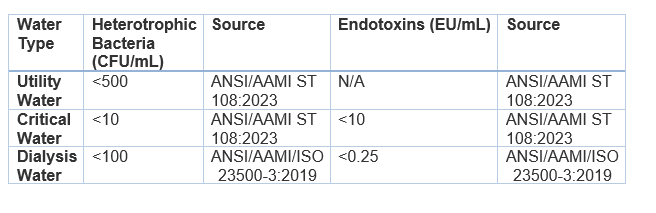
General Guidance on Endotoxin Screening
 American Analytical provides monitoring services to help detect the presence of endotoxins and endotoxin-producing bacteria before they become detrimental to your facility’s operations. Our laboratory and our staff are fully equipped in the interpretation of endotoxin levels using the gel clot LAL assay. By monitoring endotoxin levels, you can maintain ST108 compliance in your critical water systems. For persistent microbial contamination of a system, metagenomic testing is also available for a more comprehensive analysis of the microbial biofilm within your system.
American Analytical recommends that a facility should test their water systems according to the standards above that are applicable to water type and usage. Additionally, American Analytical recommends that endotoxin testing be done to ensure adequate, year-round surveillance of the water system. If a potential issue is found, American Analytical recommends that a follow up sample should be done shortly after remedial action is taken. Since these numbers represent a point-in-time of testing, it would be prudent to establishing testing on a routine basis to identify trends and potentially prevent an endotoxin issue that may be evolving.
Endotoxin Testing — 2026 LAL and Medical Device Update
Reviewed for accuracy: October 2026. USP <85> remains the controlling standard for bacterial endotoxin testing in 2026, with AAMI ST108 extending endotoxin limits into medical device processing water. FDA CDRH inspections continue to emphasize endotoxin risk on reusable device reprocessing workflows.
AATLS performs kinetic-turbidimetric and chromogenic LAL assays under ISO/IEC 17025 accreditation, supporting USP purified water / WFI (0.25 EU/mL), AAMI ST108 critical water (10 EU/mL), and AAMI RD52 dialysis water (2 EU/mL) limits. Standard turnaround 24-48 hours.
Need routine endotoxin monitoring or a one-time batch release test? Call (928) 985-9399.