
Understanding ANSI/AAMI ST108:2023 Water Standards
ANSI/AAMI ST108 Water Testing for Sterile Processing
Validate utility and critical water for medical-device reprocessing — full ST108 chemical + microbial panel. ISO 17025 accredited. Get a free ST108 sampling plan.
Thank you!
Your request has been received. We'll get back to you within one business day.
Are you in compliance?
In 2023, the Association for the Advancement of Medical Instrumentation (AAMI) has published, ANSI/AAMI ST108:2023 – Water for the Processing of Medical Devices. This new standard replaces AAMI TIR34:2014, the standard that previously set requirements for processing and cleaning of medical devices. This new standard is directed at providing medical professionals with information and requirements specifically for the water used in these processes. The unique usage of this water requires that they meet strict performance standards not only for chemical makeup, but also for microbiological contamination.
From the AAMI website:
Adverse Effects of Poor Water Quality
Water impurities can have adverse effects on medical device processing, including:
- Adverse effects to the PRODUCT:
- Corrosion, pitting, scaling
- Biomass build-up
- Increase microbial load or endotoxin content
- Adverse effects to the PROCESS:
- Decreased effectiveness of detergents
- Degradation of the water system (biofouling or scaling)
- Adverse effect to the PATIENT:
- Infection
- Toxicity
Understanding the Critical Role of Water Quality
Water quality is a pivotal component in the effective cleaning and processing of medical devices. Proper water quality ensures that cleaning agents function at their best and that devices are thoroughly rinsed, minimizing residual contamination. Without water of the specified quality, even the most well-validated procedures can fall short, leading to compromised device safety and performance.
Sterile processing personnel must be vigilant in recognizing water quality issues that could lead to adverse patient outcomes. Awareness of indicators such as unusual residue or inadequate rinsing can be vital in identifying potential water quality problems early on.
Conclusion
The impact of water quality on medical device processing cannot be overstated. Ensuring the use of water that meets specific quality standards is essential not only for the integrity of the devices themselves but for safeguarding patient health. By maintaining high water quality standards, healthcare facilities can enhance the overall efficacy of their sterilization processes.
Water impurities can have adverse effects to medical device processing, including:
- Adverse effects to the PRODUCT:
- Corrosion, pitting, scaling
- Biomass build-up
- Increase microbial load or endotoxin content
- Adverse effects to the PROCESS:
- Decreased effectiveness of detergents
- Degradation of the water system (biofouling or scaling)
- Adverse effect to the PATIENT:
- Infection
- Toxicity
It is important that sterile processing personnel understand the water quality issues that can contribute to adverse patient events and be aware of some of the gross indicators that suggest that there may be problems with the water quality.
The following table details the basic parameters that need to be monitored for the different types of water used in processing.
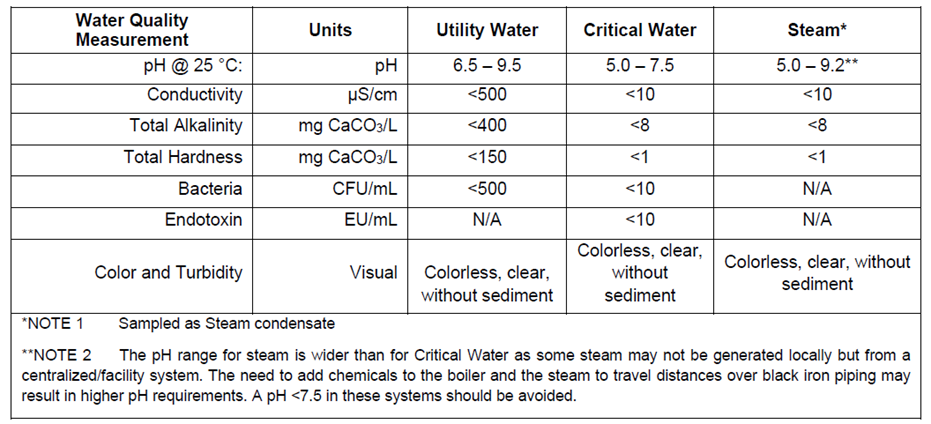
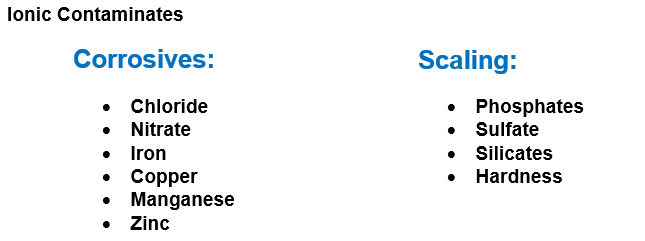
In addition to the general requirements that are monitored on a monthly or quarterly basis depending on type of water (utility, critical or steam) the following ionic contaminates need to be evaluated annually.
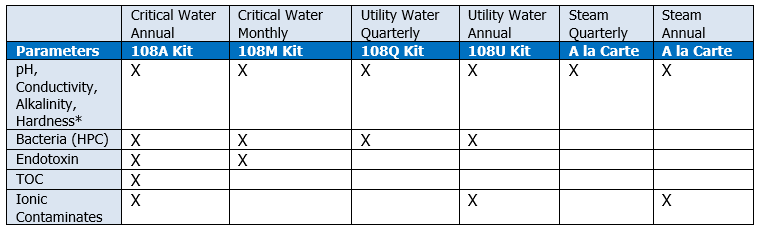
American Analytical recommends that a facility should test their water systems according to the standards above that are applicable to water type and usage. We provide full-service laboratory analysis for all the analytes required by ANSI/AAMI ST108:2023.
Endotoxin Testing
Occasionally, endotoxin may be desired or requested outside of regulatory needs, traditionally as a part of the systems validation. American Analytical recommends that a follow up sample should be done shortly after remedial action is taken, typically within 24 hours. Since these numbers represent a point-in-time of testing, it would be prudent to establishing testing on a routine basis to identify trends and potentially prevent an endotoxin issue that may be evolving.
Learn More About Endotoxin Testing With American Analytical Here
Testing Methodology & Details
Methods Used
- Bacterial endotoxin — Limulus Amebocyte Lysate (LAL)
- Total Organic Carbon (TOC) — UV/persulfate oxidation
- Conductivity — calibrated cell measurement
- Microbial enumeration — heterotrophic plate count (HPC)
- Chemical purity per AAMI ST108 specifications
Turnaround Time
Endotoxin and TOC: 24–48 hours. Microbial: 48–72 hours. Full ST108 compliance reports consolidate all parameters into one document.
Compliance
All testing is performed under ISO 17025 accreditation. Reports are formatted to meet AAMI ST108, Joint Commission, CMS, and FDA requirements for healthcare facility water quality.
Frequently Asked Questions
Pricing & Ordering
View current pricing and order tests directly through our secure online portal.
Or call us directly: (928) 985-9399
Request a Quote
Fill out the form below and we’ll respond within 1 business hour.
Thank You!
We’ve received your inquiry and will respond within 1 business hour.
If urgent, call us directly at (928) 985-9399
AAMI ST108 — 2026 Compliance Update
Reviewed for accuracy: October 2026. ANSI/AAMI ST108:2023 remains the current standard for water used in medical device processing. Joint Commission and CMS surveyors continue to expand documentation expectations in 2026, including monitoring frequency, trend analysis, and demonstrated corrective-action workflows when limits are exceeded.
Recent guidance from AAMI clarifies expectations for ambulatory surgery centers and dental settings — facilities that historically relied on tap water for instrument processing now need documented critical water programs. AATLS provides ISO/IEC 17025 accredited endotoxin (LAL), TOC, conductivity, HPC, and chemical purity testing aligned to the ST108 specifications, with reports formatted for surveyor review.
Considering a monitoring program for 2026? Our team can advise on sampling frequency, point-of-use vs storage-tank testing strategies, and the documentation package needed for survey readiness. Call (928) 985-9399 or use the form below.